You know your worth. You’ve known it for a while now. You saved a lot of know your worth quotes. You could say it out loud right now, without hesitating, and mean every word.
And you still did it again last week. Said yes when your whole body was screaming no. You did people pleasing. Smiled through something that made you feel small. Apologised for a feeling you were completely entitled to have.
If that sentence just made your chest tighten a little — good. Stay here for a second. This one’s for you.
Here’s what that moment actually looks like from the inside — every layer of it.
Everyone tells you to know your worth. Nobody tells you what your voice is supposed to do in the three seconds after it’s tested. So you get the feeling right, and the moment still gets away from you, and then you go looking for another quote to fix it. That’s not a coincidence. That’s the whole industry working exactly as designed — sell you the belief again, every time the belief fails to hold.
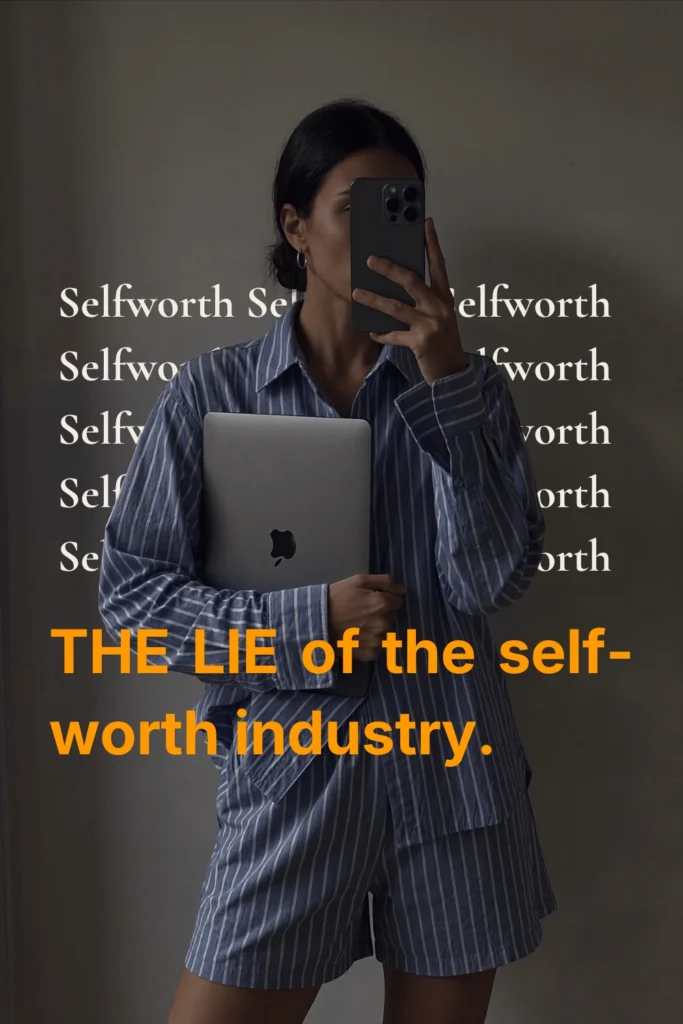
I bought into it completely. I had a phone case with a worth quote on it. I saved the graphics. I said the affirmations in the mirror some mornings, actually meant them, actually felt something lift in my chest for a minute. And I still went into rooms and gave away things I had already decided not to give.
You’ve had that morning too. The one where you feel strong, clear, done shrinking — and by the afternoon you’re already back to smaller than you meant to be. That whiplash isn’t a character flaw. It’s what happens when someone hands you a feeling and skips the part where they tell you what to do with it under pressure.
The Tuesday I still think about
I can tell you the exact day. A Tuesday, early afternoon, a meeting room with a table I didn’t choose and a chair that always felt slightly too far from the door. Someone slid a deadline across that table — casually, like it cost nothing — that meant giving up a weekend I had already promised to someone I loved.
I felt it happen before I understood what was happening. My stomach dropped first. Then my face did the thing it always did — that small automatic softening, the one that shows up right before I give something away. I heard myself start explaining. Reasons. Context. A little laugh to soften it, the kind that isn’t really a laugh.
I said yes.
I was not confused about my worth in that moment. I want you to sit with that, because I think you’ve lived a version of it too. I knew exactly what I deserved. I could have written you an essay on it. None of it was in the room with me. There was a feeling in my chest and nothing in my mouth.
You know this room. Maybe yours doesn’t have a table. Maybe it’s a phone call with your mother where you find yourself apologising for a boundary you haven’t even finished stating. Maybe it’s a text from someone who has a gift for making your no sound unreasonable before you’ve even said it. Same drop in the stomach. Same softening in the face. Same nothing where the words should be.
The sentence you say right before you fold
Here’s the part that almost nobody names honestly, because it’s the part that implicates the reader instead of the culture. You don’t usually just cave in silence. You explain first. You build a case, like the other person is a judge and your no needs a defense before it’s allowed to exist.
I did this for years in a relationship I stayed in longer than I should have — adjusting my needs down, quietly, sentence by sentence, until there was almost nothing left of what I’d actually wanted. Every time, I explained instead of answered. A decision doesn’t need a case. It needs a sentence. I didn’t have one.
There’s a specific sentence I hear women say right before they fold, and it’s almost never the one they think it is. It’s not the no. It’s the thing said two beats before the no — the sentence that quietly hands the other person an opening to keep pushing. If you’ve ever caught yourself starting a sentence with “I just feel like maybe…” right before giving something away, that’s the one. You’ve said it. I’ve said it hundreds of times. It’s not weakness. It’s a reflex nobody ever taught you to replace.
Knowing your worth was never the problem. The problem is you have no idea what to do with it the second it costs you something.
Read that again. Not because it’s clever — because I think it’s the truest sentence in this whole piece, and I think some part of you has known it for a long time without having the words for it.
If you want to understand why this keeps happening even after you’ve done the work — actual therapy, actual self-awareness, actual understanding of where it comes from — that’s a different piece. I get into it fully in Why Understanding Yourself Completely Still Isn’t Enough, because believing in yourself and holding your ground under pressure are not the same skill, and nobody ever told you that either.
What it actually feels like to close this gap
I’m not going to tell you to believe in your worth more. You already do. I spent years thinking the fold meant I hadn’t healed enough, hadn’t affirmed enough, hadn’t internalised it deeply enough — and every single time, the truth was smaller and harder to hear: I simply did not have the words built for that exact moment, and belief was never going to build them for me.
Once I saw that, something in me went quiet in a different way. Not fixed. Not transformed overnight. Just — done handing my no over to whoever pushed hardest for it. I started noticing the moment before the fold instead of only the moment after. That noticing is the whole beginning of it.
You are allowed to want that too. Not a bigger feeling. Not a stronger affirmation. Three sentences, ready, before you’re ever in that room again. That’s what I actually built for the version of me who was still in it — and it’s what I hand to you now, if you want it.
I didn’t write this to make you feel bad about the quotes you’ve saved or the affirmations you’ve said in the mirror. I wrote it because I spent years fully convinced of my own worth, standing in rooms, giving pieces of it away anyway, wondering what was wrong with me. Nothing was wrong with you. You were just never given the words. If this is the first time someone’s said that to you plainly — I’m glad it landed here.
For the exact three sentences I use now, before I ever get near the no, that’s what’s waiting for you in the freebie below. Not another reason to know your worth. The actual words for the moment it’s being tested — the part every quote conveniently leaves out.
P.S. — I still have that phone case. I don’t need the quote on it anymore. I keep it on my desk now as a small, slightly embarrassing reminder of how long I waited for the right words to just show up on their own. They never did. I had to build them.