There is a version of this you already know. You need something specific from someone. Instead of naming it, you build the case for it first — the context, the reasons, the three examples that prove you’re not being unreasonable. By the time you get to the actual ask, you’ve talked for two minutes and said nothing anyone could act on.
You know this move because you’ve made it today, possibly this week, possibly in the last conversation you had before opening this.
I built my whole communication style around the case-building. Explain enough and no one can say no. Justify enough and no one can call you difficult. It’s not weakness. It’s a strategy. The problem is it doesn’t work — it just delays the ask long enough that most people stop listening before it arrives.
What I was doing instead
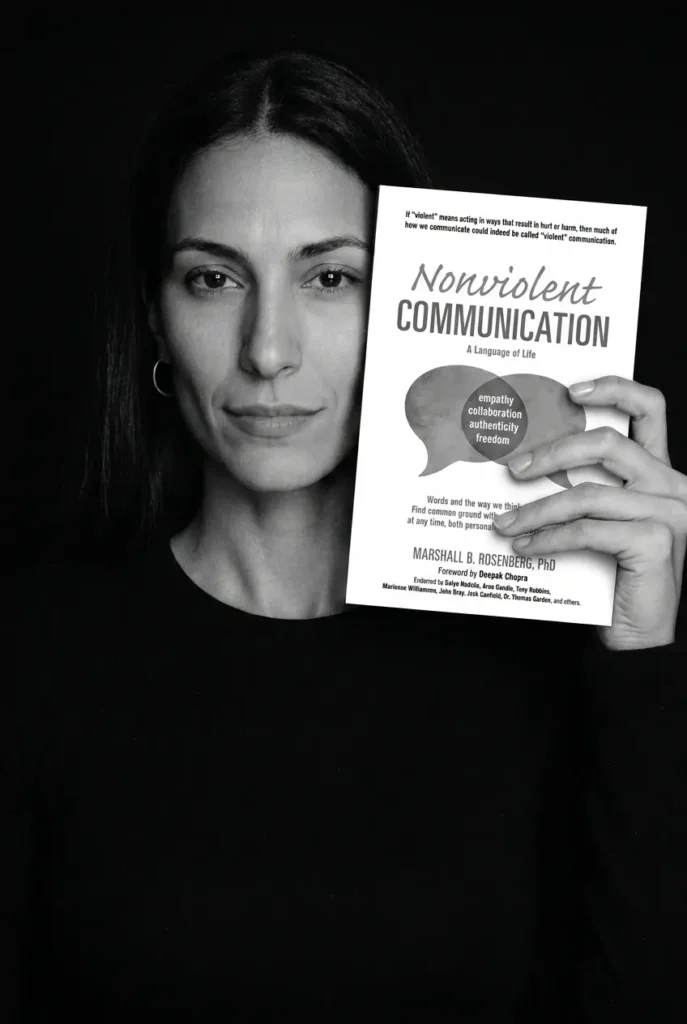
I read a book on nonviolent communication years ago — Marshall Rosenberg’s work on how to say what’s true without triggering defensiveness. I understood the theory the week I read it. It changed nothing about how I actually talked, because I kept doing the version I already knew: describe the situation, describe how reasonable I was being, hope the other person connected the dots to what I actually wanted.
That’s the failed alternative. Not silence — over-explanation. It feels like communication. It functions like avoidance, because the actual request never lands clearly enough for anyone to say yes to it.
You’ve probably noticed the same thing in yourself: the longer the windup, the less anyone remembers what you asked for.
The move: The Straight Ask
The structure is four lines, said in order, with nothing added between them.
Line one — what happened. Describe the specific action, not the pattern, not the history. “You’ve cancelled our last three plans” — not “you never make time for me.”
Line two — how it landed. Name the feeling in one word or a short phrase. “I felt sidelined.” Not “which really makes me think you don’t care about this relationship” — that’s a judgment wearing a feeling’s clothes.
Line three — what you need. State the need underneath the feeling. “I need to know I can count on plans we make.” This is the line most women skip straight past, because naming a need feels more exposed than naming a complaint.
Line four — the specific request. One sentence. Something the other person can actually do. “Can we pick one night this week and treat it as fixed?” Not “can you just be more reliable” — that’s not a request, it’s a wish.
Four lines. No case. No preamble. No three examples proving you’re justified.
I used this with the person I’d spent two years adjusting for — the relationship where I’d trained myself to raise things sideways, in the middle of unrelated conversations, hoping they’d land without me having to hold them directly. I said the four lines out loud, in order, and stopped talking. It was maybe fifteen seconds. It felt like standing in a room with no furniture to hide behind.
The reply I got back was clearer than any conversation we’d had in a year — because for the first time, there was something specific to reply to.
That’s what changed. Not the outcome of that one conversation. The fact that I’d said something a person could actually respond to, instead of something they had to decode.
The gap this doesn’t close
The four lines hold up. Built this way, in this order, the ask stops dissolving into justification — that part I stand behind completely. But building it is still a construction job, and construction takes time. It’s fine when you have thirty seconds and a clear head. It’s a different task entirely when someone asks you for something you don’t have room for and you feel yourself starting to fold — there’s no time to lay four lines in order while your chest is already tightening. That’s the actual limitation. Not the method. The moment.
The Standard Script exists for exactly that gap. It covers seven moments where women fold most often — the capacity one included — and for each, the sentence isn’t something you build. It’s already built. Not a structure to apply under pressure. The sentence itself, ready to say.
If you’ve read Why Knowing Your Worth Doesn’t Stop You From Folding, you already know why understanding this framework in a book was never going to be the same as having it ready under pressure. That’s the same gap covered from a different angle in The One Sentence That Stops You Mid-Fold.
Today’s script was yours to build. What’s behind the link is already built — for the moment that’s coming from the other direction.
[Get The Standard Script →]
P.S. — I still build the case sometimes, especially with my family, where twenty years of the old pattern doesn’t unlearn itself because I read a book once. The difference now is I notice it happening around line three of the old version instead of never. That’s still progress. It’s just quieter than I expected it to be.