I can explain my own pattern like I’m reading it off a card. Where it started. What it was protecting me from. The exact sentence I say right before I fold — before I agree to something I already, clearly decided against. I could recite the whole thing out loud and still do it again in the next room. I know what people pleasing is.
Here is what finally stopped me from believing that understanding was the finish line.
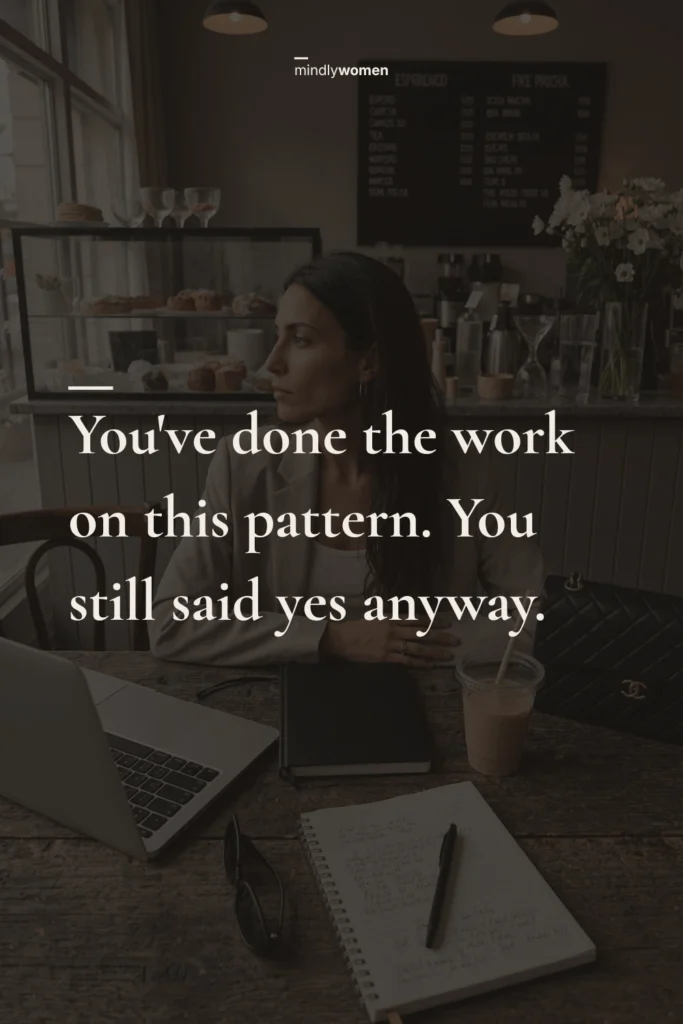
You have probably done more of the work than anyone gives you credit for. Therapy. Books on attachment. Journal pages that named the wound with total accuracy, at two in the morning, in your own handwriting. And you still watched yourself do the exact thing you swore, in writing, you would not do again.
The industry that taught you to understand yourself this completely never once taught you what to do with your mouth already open and the wrong word already forming. It sold you the diagnosis and called it the cure.
You know the version of this that is yours, not mine. The specific sentence. The specific person across the table. The specific half-second where your voice changes right before you give in.
Why understanding a pattern isn’t the same as changing it
Mine happened in a meeting room, on a Tuesday afternoon. Someone asked me to take on a piece of work I had already decided, calmly and clearly, I would not take on. I heard myself say yes anyway. I watched it happen from a small distance, like I was on the other side of a window. I understood exactly why I was doing it, in real time, mid-sentence — and understanding it changed nothing about the sentence.
That was the moment I stopped believing insight was the finish line. It was the start of something. It was not the something.
Here is the part nobody explained to you: your brain runs two systems on a moment like this. One is language — the part of you that can explain, remember, and reason. The other is what’s called the nervous system’s threat response: a faster system, built to protect you, that reacts before the thinking part of your brain gets a vote. When a pattern like this fires, it does not check with your understanding first. It just runs.
This is why you can know the sentence you want to say and still not be able to say it. By the time you need it, the faster system already has your mouth moving.
Think about a fire drill. You can memorise the exit route until you could walk it with your eyes closed. But if you have only ever read it off a laminated card, and never actually walked the hallway with real smoke in it, your body does not know that route — only your mind does. The first time smoke actually fills a room, most people do not calmly walk to the door they memorised. They freeze, or they follow whoever moves first. You have memorised your exit. You have not walked it once under real pressure.
Why talking about the pattern doesn’t stop the pattern
This is the part that goes against almost everything the self-awareness industry told you: talking about a pattern, understanding it, even reliving it with real emotion, does not automatically resolve it. I have watched — and lived — the version where someone narrates the same old moment for months or years, replaying the fear and the anger inside it, and still stays exactly where she started. Naming a thing is a different act from finishing it.
I get some version of this message from a woman most weeks. I have well over 600 of them saved now, and almost all of them say the same sentence in different words: I understood the pattern completely, and I did it again anyway.
“Understanding was never the cure. It was the diagnosis they handed you and called it done.”
You are not behind. You did not miss a step. You were handed a map with no road on it and told the map was the destination.
What actually closes the gap
Understanding never once told me what to say instead, in the second the old sentence was already halfway out of my mouth. That part I had to build on my own, mostly by getting it wrong first, for a long time.
What closed it for me was not more explaining. It was catching the half-second right before I said yes — the pause itself, practised on purpose, away from any pressure, until it started showing up inside the pressure too. I don’t call it therapy and I don’t call it a mantra. I just call it The Pause. It is the smallest possible habit, built the same boring way any reflex gets built: on purpose, repeated, outside the moment that actually needs it, until it shows up inside that moment without being asked.
I stopped trying to think my way out of the room and started practising something specific to say inside it instead — <a href=”#”>the one sentence that buys you three seconds before you fold</a> — the same handful of words, rehearsed until they were faster than the old yes. That is not a claim about how deep trauma resolves. It is simpler than that. It is what worked: not narrating the pattern one more time, but giving myself something to reach for in the exact second the old response usually wins.
You already know what your version of that sentence needs to hold off. The exact moment you agree to something you already decided against is not a mystery to you — you have lived it enough times to describe it in your sleep.
I know this closes the gap because I tried the other way for years. I had the explanation. I did not have the reflex. The fold kept happening on schedule, fully understood, completely unchanged — right up until I gave myself something to say instead, and said it enough times that it stopped taking effort.
Once you understand that insight and behaviour live in two different places, something in you gets to stop being disappointed in yourself every time you understand something perfectly and still do the old thing. That disappointment was costing you almost as much as the pattern itself. You were never slow to learn. You had simply never practised anything else in the room where it counted.
I did not write this to tell you what to do next. I wrote it because I spent years fully understanding myself and still folding on schedule, and nobody had told me those were two separate problems. If this is the first place you are hearing that — that is enough for today.
If this named something you already understand better than most people you know — the next step isn’t more understanding. I built a free 5-day sequence that starts where this article ends: it names the pattern, walks through the mechanism in plain terms, and hands you one small, usable move by the end of day five. You will find it below.
P.S. — I still don’t get it right every time. Four months ago, same kind of room, different meeting, I felt the old sentence start to form and caught it one breath later instead of not at all. That’s the whole game. Not perfect. Faster.